


-
Beyond Compliance: Trauma-Informed Leadership as Healthcare Quality
There is something profoundly human about the work of healing. It is rarely linear, seldom predictable, and almost never confined to the structured boxes we create within healthcare systems. Yet somewhere between regulatory requirements, productivity expectations, and clinical documentation, we can...
-
Moving Behavioral Health Inside Women’s Health Programs
According to UN Women, women spend about 2.5 times as many hours as men on unpaid care work, like caring for family members and managing household needs. The extra hours weigh heavily on their mental health, and 47% of women surveyed for Iris Telehealth's Invisible Load Index said they...
-
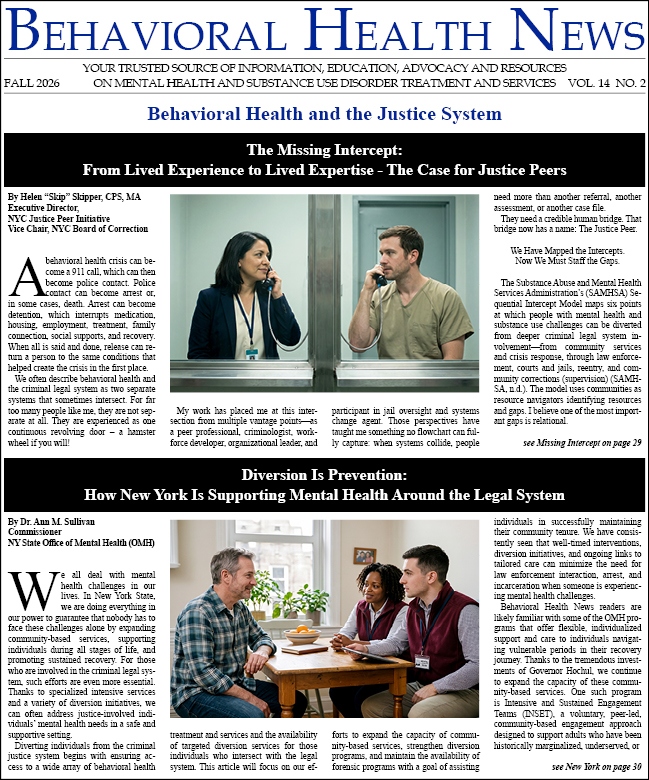
The Missing Intercept: From Lived Experience to Lived Expertise – The Case for Justice Peers
A behavioral health crisis can become a 911 call, which can then become police contact. Police contact can become arrest or, in some cases, death. Arrest can become detention, which interrupts medication, housing, employment, treatment, family connection, social supports, and recovery. When all is...
-
Diversion Is Prevention: How New York Is Supporting Mental Health Around the Legal System
We all deal with mental health challenges in our lives. In New York State, we are doing everything in our power to guarantee that nobody has to face these challenges alone by expanding community-based services, supporting individuals during all stages of life, and promoting sustained recovery. For...
-
Preventing Forensic Involvement Through Continuous Care
When our behavioral health, housing, and social service systems are unable to adequately meet the needs of people with serious mental health challenges, those individuals too often find their way into the criminal justice system without the treatment and support they need. The path to...
-
Financial Stability: Building Practical Infrastructure for Reentry
James1 completes a 90-day residential treatment program with a job interview set up for the coming week and a probation meeting he cannot miss. He also leaves with thousands of dollars in outstanding legal financial obligations (LFOs), a suspended driver's license related to unpaid fees, and no...
-
The Role of CCBHCs in Reducing Incarceration
For decades, jails and prisons have functioned as the nation's largest, and least appropriate, providers of mental health and substance use treatment. People with untreated serious mental illness (SMI) and substance use disorders (SUD) often move repeatedly through arrest, incarceration, release,...
-
From Juvenile Hall to Clinical Care: De-Escalating Youth Trauma Through Deflection Pathways
This article examines how youth deflection differs from traditional diversion, and how behavioral health leaders are using deflection programs to de-escalate trauma and keep adolescents out of the justice system. Communities increasingly seek preventive alternatives to juvenile detention. Seven...
-
The Director Who Was Once the Intake: What Justice-Involved Clients Taught Me From Both Sides of the Desk
I have occupied three chairs in the behavioral health system's relationship with justice-involved people: the client in the residential program with a record behind him, the counselor across the desk, and the director deciding who gets the bed. Most practitioners spend a career in one of those...
-
A Trauma-Informed Approach to Justice-Involved Veterans
For many veterans, justice involvement does not happen in isolation from their life experiences. Trauma can shape how a person responds to stress, authority, relationships, and support, and for some veterans, those experiences may be connected to post-traumatic stress disorder (PTSD). PTSD can...
-
Community Integration, Economic Security, and the Promise of Olmstead
True economic security for individuals with intellectual and developmental disabilities is shaped by whether individuals have meaningful opportunities to work, earn income, build relationships, make choices, and participate fully in their communities. Financial planning and economic security for...
-
Beyond Either/Or: Where Assisted Outpatient Treatment Fits in Mental Health Care
Debates over Assisted Outpatient Treatment (AOT) too often ask us to choose a side. Either we respect autonomy and rely exclusively on voluntary treatment, or we accept coercion as necessary to ensure people receive care. Neither position adequately reflects the complexity of serious mental illness...
-
Why Caregiver Involvement Is a Cornerstone of Treatment for Adolescents with Problematic Sexual Behavior
Adolescents with Problematic Sexual Behavior – just the phrase conjures up stereotypes of these youth as “mini sex offenders.” For many years, treatment approaches for these youth were founded on a set of principles drawn from theories about adult pedophilia. Treatment protocols for youth...
-
The NYSPA Report – Treatment Before Arrest: Why Diversion Begins With Engagement
When psychiatrists discuss behavioral health diversion, we usually mean redirecting a person away from arrest, jail, or prosecution and toward treatment. Mental health courts, crisis-response programs, and alternatives to incarceration are essential; yet if diversion begins only after...
-
The NYSPA Report – The Fifteen-Month Clock: Substance Use Disorder, Recovery Timelines, and the Law’s Deadline for Parents
The forensic dilemma at the intersection of substance use disorder (SUD) and family law appears at several junctures: pregnancy, child welfare, custody and divorce, juvenile justice, and education. Pregnancy is an especially telling case, a physical state that invites a future orientation toward...
-
Justice-Impacted Older Adults: Supporting a Vulnerable Population
When we think about justice-impacted older adults, there are three facts we need to keep in mind: A post-incarceration transition is difficult under the best of circumstances. Justice-impacted older adults tend to have complex behavioral and physical health needs. Adults over age 60 are...
-
Beyond Deinstitutionalization: Unraveling the Complex Criminalization of Serious Mental Illness in America
Individuals with Serious Mental Illness (SMI) are disproportionately represented among the populations of the nation's correctional facilities. Some have dubbed jails and prisons the "New Asylums" as the criminal justice system has become the de facto service provider for individuals with severe...
-
Closing the Re-Entry Gap: Connecting Justice-Involved Individuals to Addiction Treatment
Individuals in incarcerated settings are found to have an increased risk of overdose and drug-related injury during community re-entry, with the first two weeks carrying the most risk (Hartung et al., 2023). Justice-involved individuals face significant barriers to accessing substance use services...
-
Decriminalization Alone Won’t Fix Addiction – Infrastructure Will: A Comparative Look at Portugal, the Netherlands, and the U.S.
In Chasing the Scream: The Search for the Truth About Addiction, Johan Hari asks, "What if everything you think you know about addiction is wrong?" (Hari, 2015). Hari posits that addiction is driven by isolation more than chemicals. In a widely viewed TED Talk he states, "The opposite of addiction...
-
Still Arresting Our Way Out: Why New York Needs to Expand Its Diversion Courts
For decades, New Yorkers dealing with mental health and substance use issues have been funneled into our jails and prisons and denied the treatment they need to get better. Far too often, local correctional facilities end up serving as the default mental health provider. New York is not alone in...
-
Nobody Listened Until She Was in a Courtroom: Postpartum Illness and a Diagnosis That Runs Out
Dana came onto our unit nineteen weeks after she delivered her son. Her husband got up at two that morning and found her side of the bed empty. She was in the baby's room, sitting straight up in the rocking chair, not rocking, looking at the wall. She did not lift her head when he came in, or when...
-
Relationship-Driven Recovery: Reimagining Behavioral Health Support for Justice-Involved Individuals
For many people leaving jail or prison, release isn't just the end of a difficult journey; it's the beginning of an entirely new set of challenges. Returning to the community often means rebuilding nearly every aspect of daily life: obtaining identification, securing housing, finding employment,...
-
A Qualitative Exploration of ADHD, Prosocial Bonds, and the School-to-Prison Pipeline
Symptoms of Attention Deficit and Hyperactivity Disorder (ADHD) affect up to 11 percent of children (Visser et al., 2013). There is strong empirical evidence that an ADHD diagnosis puts children at higher risk for significant academic impairment, weaker ties to pro-social institutions, increased...
-
Dr. Isaac Mawuko Adusu Named 2026 Community Leader of the Year for Advancing Disability Inclusion
Dr. Isaac Mawuko Adusu, a health and human services executive, disability advocate, and frequent contributor to Behavioral Health News and Autism Spectrum News, has been named the 2026 Community Leader of the Year by the Inclusive Leadership Impact Awards, recognizing his work to advance inclusion,...
-
Westchester’s Behavioral Health Diversion Continuum: A Roadmap Through the Justice System
The intersection of the criminal justice and behavioral health systems is neither a point nor a straight line. Rather, the overlap of these systems is a continuum; one in which the inflection points of systemic cross-contact can be identified and potentially addressed. The clearest tool for...
-
It’s 2026. Why Are Peers Not Front and Center in Our Mental Health Crisis Response System in NYC?
The movement toward non-police-based responses to mental health crises in our city has taken on many shapes and sizes. For years, efforts were made to train NYPD rookies, sergeants, and captains on appropriate crisis intervention techniques. Over three days of intensive training at the police...
-
Behavioral Health and the Justice System: Accreditation and Continuity-of-Care Standards for Justice-Involved Individuals Entering SUD Treatment
Men and women leaving jails or prison face some of the highest overdose risk of any population in the country. Typically, by the 3rd month of release, an estimated 75 percent of previously incarcerated people with an opioid use disorder (OUD) experience a return to opioid use, and formerly...
-
Beyond Punishment: Rethinking Behavioral Health Care in the Justice System
Correctional facilities in the United States have increasingly become major providers of mental health care (Cherson, 2025). One in every two to three people incarcerated in U.S. prisons is estimated to live with a mental illness, far higher than the general population (Dumont et al., 2012)....
-
Florida’s Youth Incarceration Problem Has a Proven Fix
Florida incarcerates more children than any other state in the country. Even while research shows harsh punishments and long sentences don't rehabilitate kids — they keep them coming back. There needs to be another way to hold kids accountable because, right now, we are manufacturing the outcomes...
-
The Justice System’s New Role in Behavioral Health Compliance
The relationship between behavioral health and the justice system has traditionally been characterized by courtroom interaction, diversion programs, and people moving through a system built to process them. Today, that relationship is changing rapidly as the justice system ramps up oversight of...